Garage Door Opener Repair in Macomb, IL
A hum with no lift, a door that bounces back before reaching the floor, a fob that went quiet: around Macomb, most opener faults come from a short list of parts, and many can be repaired.
Where a unit is too far gone, a new one suited to your door and your habits takes its place. Some trouble isn't the opener's fault, and you can handle a few causes yourself, so skim the checklist first.
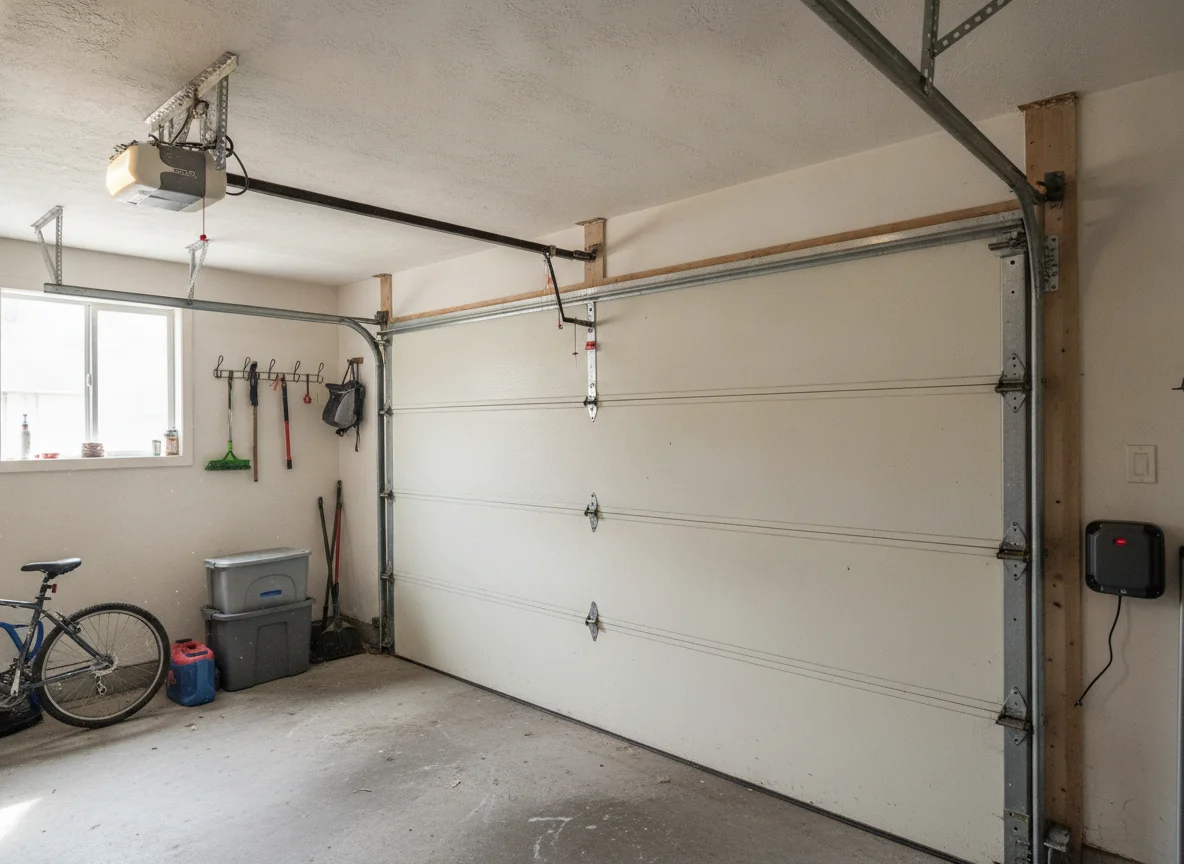
Frequent opener faults
Motor whirs or clicks while the door stays put
A stripped drive gear, a worn-out capacitor, or a door that's too heavy because a spring has broken.
Heads down, then reverses upward
The safety eyes come first: knocked out of line, dirty, loosely wired, or dazzled by low sun. Otherwise the close force may be set wrong, or the door rubs in its track.
It quits halfway down
Limit settings have wandered, or the unit met resistance beyond what it was tuned for.
Fob or keypad won't respond anymore
Flat batteries, a pairing erased in a blackout, or the panel's lock button pressed without meaning to.
It has grown louder lately
A slack chain, worn gears, or rollers that bind in the rail and make the motor work harder.
Total silence from the unit
Nothing at the outlet, a breaker that tripped, or a dead control board.
Motor spins, door stays shut: the trolley has come unlatched from the carriage
Someone tugged the red cord, or the arm popped out of the carriage.
Does the opener hum, click or bounce back? Tell us what happens after you press the button.
Contact UsTry these before calling
Some apparent breakdowns take a minute to cure, and a service call to discover them is wasted money:
Outlet
Is the opener's bulb lit? Test the outlet with a lamp, then glance at the panel for a tripped breaker.
Lock setting
Lots of wall consoles hide a lock or vacation switch that cuts off every fob, and it's easy to hit by accident.
New cells for the key fob and the keypad.
Safety eyes
Two small units face each other at the bottom of the tracks, each with a status light. If one is dark or flickering, the beam is interrupted. Wipe the lenses and nudge them until both lights stay lit.
Sun glare
When the door reverses only at certain hours, sunshine on a sensor lens is a frequent cause. Shading it, or swapping the two units' sides, often solves it.
If none of that helps, or the motor hums while the door stays put, someone needs to take a proper look.
Opener or door problem?
An opener steers a door that is already balanced; hauling its full weight isn't its job. With springs gone, a healthy motor labors, stalls or reverses, and buying a new one solves nothing. Close the door and inspect the bar overhead for a gap in the coil before you condemn the opener.
If you spot a gap, jump to garage door spring repair.
Repair it or replace it?
Fixing it generally makes sense if:
one part is to blame, say a gear, sprocket, capacitor, eye, circuit board or limit setting;
spare parts are still sold for it;
aside from this fault, it runs well and is quiet enough for you.
Swapping it out generally wins when:
it lacks the modern obstruction-reversing feature
Under federal rule 16 CFR Part 1211, residential openers must reverse on meeting an obstruction. A unit built before that protection should be retired, whatever else is wrong with it;
no parts are sold for the model any longer;
fixing it would cost nearly as much as buying a fresh one;
you want what the old one lacks: hushed running, battery backup when the power fails, or control from your phone.
Picking a new opener
Chain-driven
Sturdy and plain, but the loudest. Sound when the garage stands apart from the house.
Belt-driven
Quieter in use, so it's popular where a bedroom sits above or beside the garage.
Screw-driven
Few moving parts; cold slows it, and Prairie City's January lows average 16 F.
Jackshaft (wall unit)
Hangs beside the door and turns the torsion bar, freeing the ceiling. Suits tall or odd ceilings, not every door.
Lifting power
Solid wood, double-width and well-insulated doors weigh more, so they call for extra motor power even when balanced.
Options to decide before ordering
A backup battery, a keypad, a camera, or phone control.
Ask whoever quotes a replacement whether it fits your door's weight and ceiling height, meets U.S. Consumer Product Safety Commission rules, and keeps the old wiring.
Describe the door's behavior
Start with a line or two of description; there's no need to know what the broken part is called.
Factors behind an opener repair bill
Which part is faulty
A sensor or fob swap is small; a stripped gear or dead board is a bigger job.
Brand, model and age, and whether parts can still be ordered for the unit.
Fix versus replace
For a new opener: the drive style, motor size and any extras chosen.
Install type
Extra work comes with a wall-mounted unit, a tall ceiling, or an outlet that's far from the opener.
Whether the door needs work too
An opener fighting a failing spring or tired rollers keeps breaking until the door itself is sorted.
Have these handy
Copy the brand and model from the sticker on the motor unit, guess its age, and describe what follows a press of the button: nothing, a hum, a click, a partial run, or a reversal followed by silence.
A brief video of the door attempting to move is often the fastest route to a diagnosis.
When the culprit lies elsewhere
Your questions
How do I sync a fob without help?
Typically. A learn button sits on the motor unit, and the owner's manual (or the maker's website, searching your model) walks through pairing.
Why would it reverse only late in the day?
Sunshine on a sensor lens. Trade the two units' positions, or shade the receiving one with a small hood or cap.
Is it safe to use the door manually with the opener released?
Just if the springs are intact and the door is shut tight before you pull the cord. A well-balanced door lifts easily; if yours is hard going, deal with the springs first.
Can a new unit go on a door this old?
Nearly always, so long as the door runs freely and is in balance. Fitting one to a door that binds or hangs unevenly shortens its life.
More garage door work
Garage Door Spring Repair
Failed torsion or extension springs, replaced with ones that suit the door's weight.
Details →Garage Door Off Track Repair
Doors off their rails re-hung, bent track straightened, and worn-out rollers replaced.
See details →Garage Door Maintenance
A tune-up covers springs, cables, rollers and auto-reverse before anything gives way.
Read on →Reach out
Pass along the brand and model if you have them, how the unit responds at the button, and whether the door moves by hand. Please also get your estimates in writing, as the Illinois Attorney General advises.